
14th AICIF: Dr. Yulizar D. Sanrego Discusses the Integration of Muamalah Principles, Sharia Compliance, and the Regulatory Ecosystem for Islamic Finance Fatwas in Indonesia
JAKARTA, 12 August 2026 — As part of the series of events for The 14th ASEAN International Conference on Islamic Finance (AICIF) 2026, the Islamic Economics Study Program at the Faculty of Economics and Business (FEB) of UIN Syarif Hidayatullah Jakarta, in collaboration with a consortium of AICIF member universities, successfully held the Second Session of Short Course Batch 1. This session featured a leading Islamic economics expert and practitioner, Dr. Yulizar Djamaluddin Sanrego, M.Ec., a member of the Fatwa Division of the MUI National Sharia Council (DSN-MUI) and an academic at Darussalam Gontor University, as the keynote speaker.
Under the topic “Muamalah Principles, Shariah Compliance, and Fatwa Regulatory Institutions in Indonesia,” Dr. Yulizar provided a comprehensive presentation on how the principles of fiqh muamalah are transformed into a framework for Shariah compliance and binding positive law regulations in the modern financial industry.
Controlling Economic Desires Toward the Maqashid al-Shariah
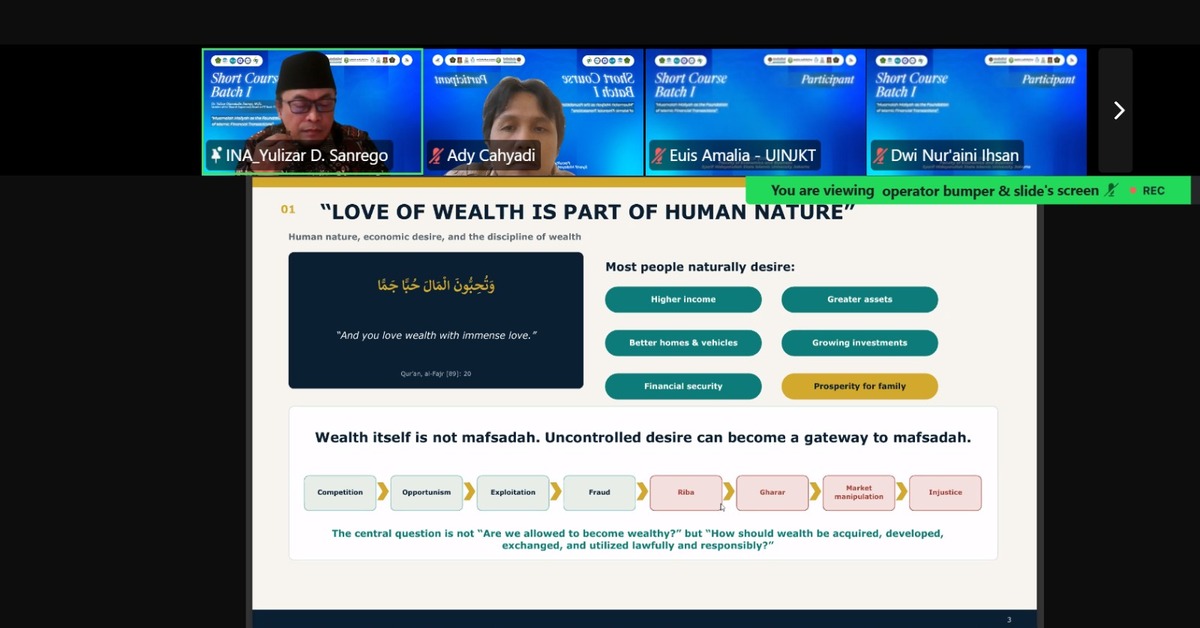
Opening his presentation, Dr. Yulizar quoted Quranic Surah Al-Fajr [89]: 20 regarding human nature’s inherent tendency to love wealth. He emphasized that possessing or seeking wealth is not inherently harmful (mafsadah), but rather an uncontrolled desire—devoid of ethical guidance—that opens the door to exploitation, fraud, usury (riba), uncertainty (gharar), and market injustice.
“The main question is not ‘Are we allowed to become rich?’, but rather ‘How can wealth be acquired, developed, exchanged, and utilized in a lawful (halal) and responsible manner?’ This is why economic activities require Sharia-based normative guidance to prevent mafsadah while simultaneously realizing maslahah.”
— Dr. Yulizar Djamaluddin Sanrego, M.Ec.
He explained that the concept of Hifz al-Mal (preserving wealth) in Maqashid al-Shariah is not limited to increasing the amount of assets, but also encompasses lawful acquisition, protection of property rights, prevention of fraud, productive development, fairness in transactions, and the healthy circulation of wealth within society.
7 Sharia Compliance Filters & the “Fiqh Before Transaction” Principle
In the practical session, Dr. Yulizar introduced the 7 Muamalah Principle Filters that every Sharia-compliant financial product and transaction must meet:
1. Parties: Legal capacity and authority.
2. Contract (‘Aqd): Clarity and validity of the legal contract used.
3. Subject Matter: A valid, well-defined, valuable, and transferable object of the transaction.
4. Ownership & Qabd: Valid ownership, possession of the object, and transfer of risk.
5. Consideration: A legitimate basis for profit, margin, rent, or ujrah.
6. Consent & Transparency: Voluntary consent (taradhi), transparency of information, and the absence of fraud.
7. Prohibited Elements: Free from Riba, Gharar, Maysir, Zhulm, Tadlis, Risywah, and Ikhtikar.
Dr. Yulizar emphasized an important principle: “Fiqh must be applied before the transaction takes place—not after a violation has occurred.” Sharia compliance must be integrated from the product concept stage, through structuring, the issuance of fatwas, documentation, and IT systems, all the way through to execution and audit.
The Six-Tier Regulatory Ecosystem of Islamic Finance in Indonesia
Explaining the architecture of Islamic finance in Indonesia, Dr. Yulizar outlined a six-tier regulatory ecosystem in which each tier complements the others:
• Tier 1 (Sources of Sharia): The Qur’an, Sunnah, Ijma, and Qiyas.
• Layer 2 (Fiqh & Ushul Fiqh): Classical jurisprudence and contemporary ijtihad.
• Layer 3 (Fatwa): DSN-MUI as the body determining national Sharia principles.
• Layer 4 (Government Regulations): the P2SK Law (Law No. 4/2023), OJK Regulations (POJK), Bank Indonesia Regulations (PBI/PADG), and Minister of Finance Regulations (PMK).
• Layer 5 (Institutional Governance): Sharia Supervisory Board (DPS), Sharia Risk Management, Sharia Internal Audit, and Compliance Function.
• Layer 6 (Market Execution): Execution of actual transactions in banking, capital markets, non-bank financial institutions (IKNB), and the real sector.
In particular, he emphasized the transformation of fatwas (which are religious in nature/diniyyan) into binding positive law (qanuniyyan/tanzimiyyan) through the integration of regulations issued by the OJK and Bank Indonesia, as well as their application in dispute resolution (qadaiyyan). The implementation of OJK Regulation No. 2 of 2024 and SEOJK No. 15/SEOJK.03/2024 on the Shariah Governance Framework reaffirms that Shariah compliance is not merely a certificate, but rather a continuous governance process.
Participants’ Enthusiasm and the Commitment of the Faculty of Economics and Business, UIN Jakarta
The second session of this Short Course was enthusiastically attended by dozens of academics, researchers, students, and Islamic finance practitioners from various member countries of the AICIF consortium via the Zoom Meeting platform. The interactive session, guided by a moderator, featured in-depth discussions on the challenges of digital financial products, crypto assets/tokenization, and remediation mechanisms when Shariah non-compliance occurs in practice.
As the lead organizer of the 14th AICIF in 2026, the Faculty of Economics and Business (FEB) at UIN Syarif Hidayatullah Jakarta remains committed to promoting financial literacy, financial inclusion, and cutting-edge research in the fields of Islamic economics and finance at both the ASEAN regional and global levels. (AC)