
Analyzing the Three Core Principles of the OBE Curriculum: Pillars of Higher Education Transformation Toward a Future-Oriented Approach
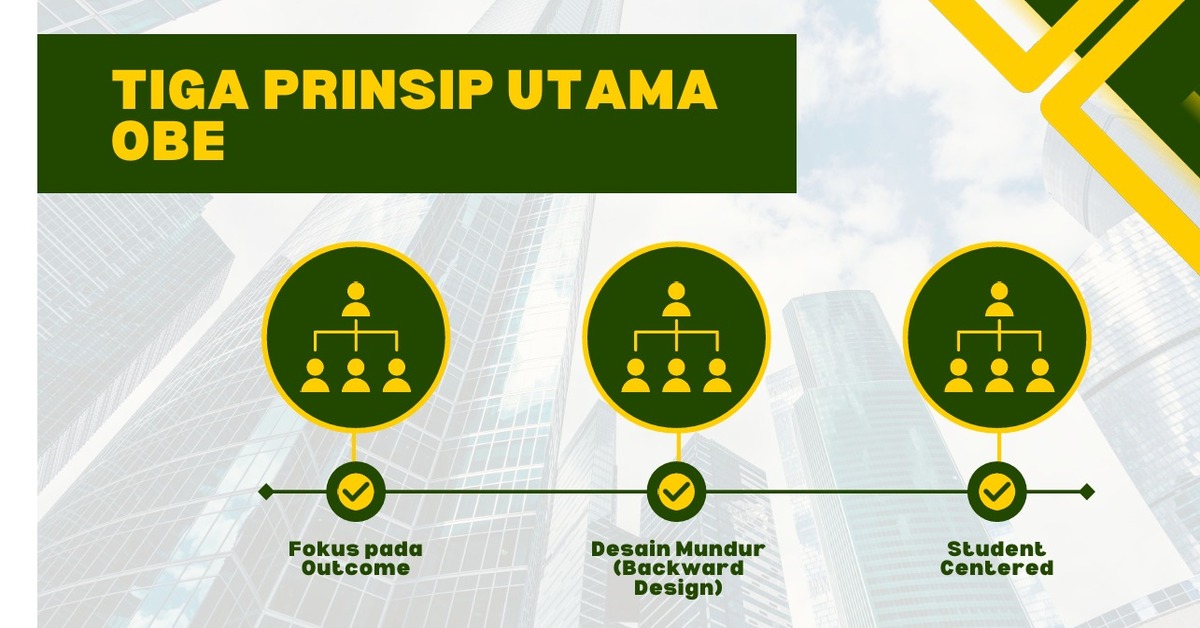
The implementation of the Outcome-Based Education (OBE) curriculum has now become the new gold standard in global education. Unlike conventional models that emphasize what educators teach (input), OBE radically shifts the focus to what students have truly mastered and are able to demonstrate after completing the learning process (outcome). The success of an educational process is no longer measured by the thickness of the syllabus or the number of face-to-face class hours, but rather by tangible evidence of students’ competencies that are relevant to the needs of the times. To fully implement this method, educational institutions must understand and integrate its three core principles: absolute focus on outcomes, backward design, and student-centered learning.
The first and most fundamental principle is Absolute Focus on Outcomes (Clarity of Focus). Under this principle, clarity regarding the final outcomes is the primary determinant. Everything done in the educational process—from course planning, classroom activities, and the selection of reading materials to the determination of assessment methods—must be explicitly directed toward helping students achieve the learning outcomes established from the outset. Educators must be able to define very specifically what competencies students must possess, whether in cognitive (knowledge), psychomotor (practical skills), or affective (attitudes and ethics) aspects. This clarity of focus provides a transparent roadmap, not only for instructors in their teaching but also for students in monitoring their own competency development.
The second principle concerns a backward-planning approach to curriculum development, known as Backward Design. In traditional curricula, planning often begins with the availability of textbooks or the instructors’ own subject-specific interests, and only then does consideration turn to the end-of-semester exams. OBE completely reverses this sequence through three structured stages. The first stage begins with identifying the desired final outcomes—namely, Graduate Learning Outcomes (GLOs)—based on an analysis of stakeholder needs and future challenges. The second stage involves determining valid and reliable assessment indicators to measure whether these final outcomes have been achieved. Finally, in the third stage, educators design the learning experiences, instructional strategies, and course materials that are most effective in helping students achieve these goals. With backward design, every course and assignment is ensured to have direct relevance, eliminating any redundant material.
The third principle shifts the central role within the classroom ecosystem through Student-Centered Learning. OBE requires the application of this principle so that students are no longer merely passive vessels passively receiving one-way lectures from instructors. In this new paradigm, students are positioned as active agents who construct their own knowledge through real-world experiences. Instructors transform their roles from “sages on the stage” to facilitators, mentors, and designers of the learning ecosystem (“guides on the side”). The learning methods employed are interactive and application-oriented, such as Project-Based Learning (PjBL), the Case-Based Method, simulations, and group collaboration to solve real-world problems in the field.
When these three principles work in synergy—where a focus on outcomes provides clear goals, backward design offers a logical structural path, and student-centered learning fosters a deep internalization of competencies—the quality of education will improve substantially. Adopting OBE is not merely a matter of updating administrative curriculum documents for accreditation purposes. These three main principles form a unified philosophy and methodology that compels educational institutions to be accountable. By integrating these three principles, higher education institutions can ensure that the investment of time, energy, and financial resources made by students will result in their readiness to become adaptive problem solvers in society and the workforce. (AC)