
Promoting Sharia-based Sustainable Economic and Development Systems, FEB UIN Jakarta Holds Public Lecture with Visiting Professor from Durham University, UK
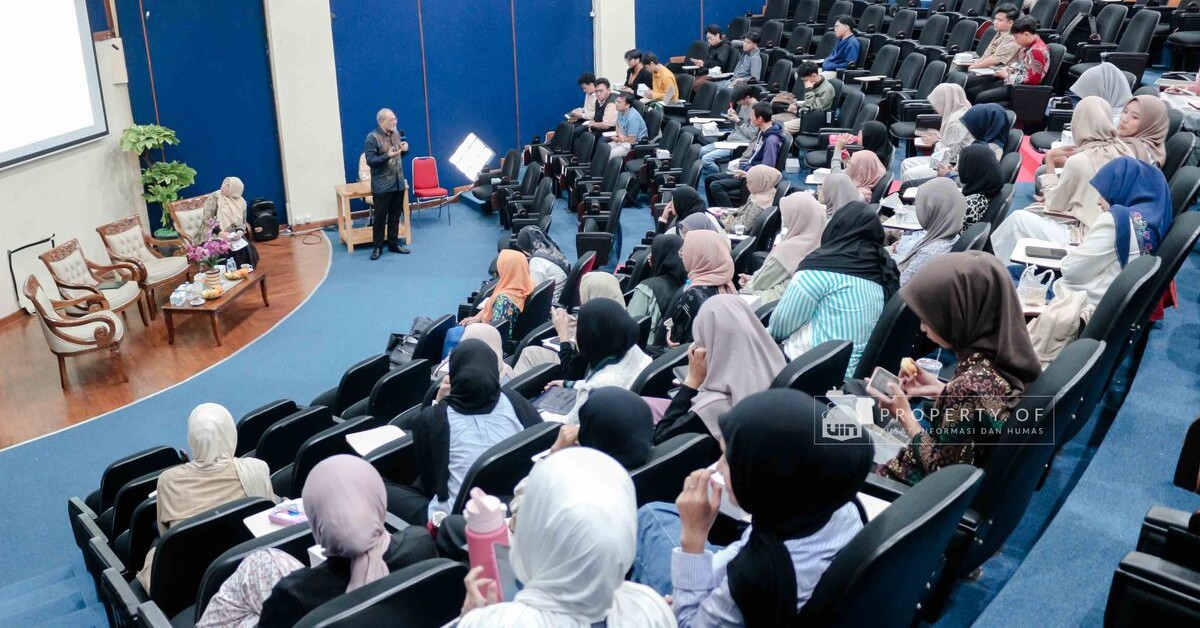
Jakarta, December 8, 2025. The Faculty of Economics and Business at UIN Syarif Hidayatullah Jakarta welcomed Visiting Professor Habib Ahmed, Head of Sharjah Islamic Law and Finance at Durham University, on December 8, 2025. This public lecture was divided into two sessions with two different themes. The first theme was “Social Inclusion and Islamic Finance: Organizational Formats, Products, Outreach, and Sustainability Comparative Learning in Islamic Countries,” and the second session carried the theme “Islamic Economic Systems and Sustainable Development: Islamic Capitalism Versus Insanism (Islamic Humanism).”
The event was attended by the Dean of the Faculty of Economics and Business, UIN Syarif Hidayatullah Jakarta, Prof. Dr. Ibnu Qizam SE., M.SI., AK., СА. In his speech, the Dean of FEB UIN Jakarta said that many economic theories have now been combined with Islamic values.
“Now we have many extraordinary theories, from conventional ones such as the well-known and popular agency theory, which has made some progress, not only from a social perspective but also from Islamic values. We also have many theories on how to analyze economics and finance combined with Islamic values. Take, for example, institutional theory, which involves agency theory combined with principles and agents,” he explained.
He also explained the Maqashid Syariah-based economic framework, which is the largest theoretical framework from an Islamic perspective and can be used as a reference for all theories.
The event continued with a public lecture by Professor Habib Ahmed, who said that the microfinance financing system that has been implemented so far actually burdens low-income communities. He explained that microfinance service costs globally tend to be higher and unfair to poor communities, even though the initial goal of microfinance was to increase financial inclusion.
“Unfortunately, the price or cost of microfinance services is actually high for poor communities.”
In addition, he also emphasized that the direction of Islamic economic development is largely determined by how the Sharia system is understood. If the Sharia system is understood only as technical rules, then the resulting Islamic economic system will be narrow and less conducive to the welfare of the people. However, if the Sharia system is interpreted more broadly and encompasses all the values and objectives of Maqashid Sharia, Islamic economics will be able to develop into a more just and sustainable system.
repost from www.uinjkt.ac.id