
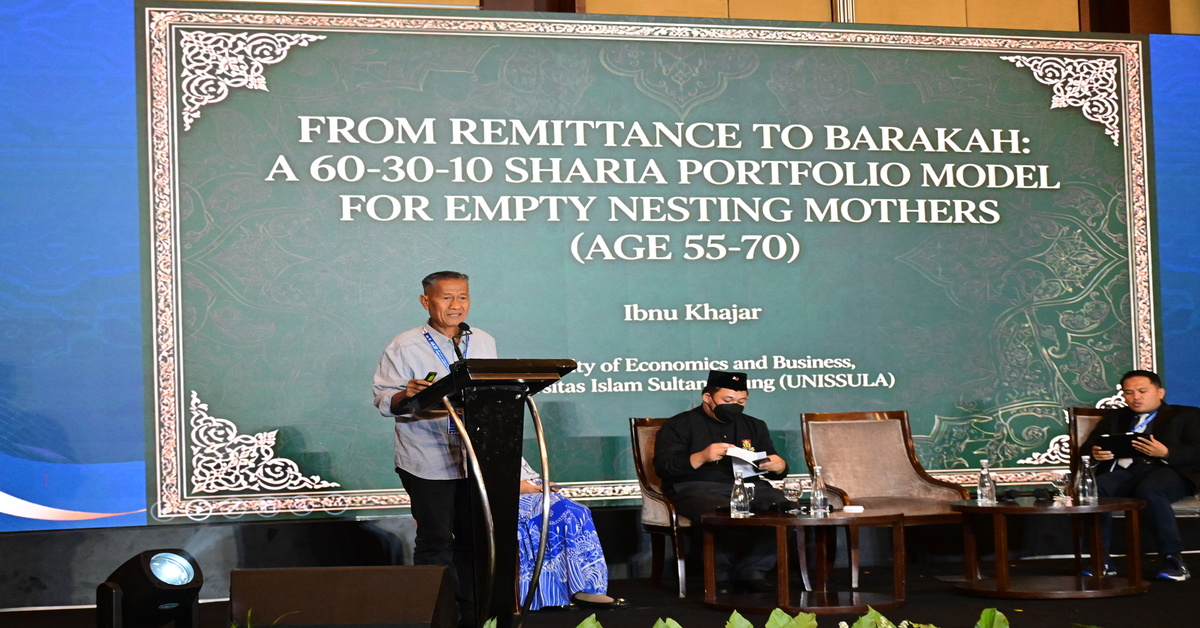
Proposing the 60-30-10 Sharia Portfolio Model, Prof. Dr. Ibnu Khajar Outlines Remittance Management Strategies for Elderly Mothers at the 14th AICIF
SERPONG, OCTOBER 14, 2026 — The series of events at the 14th ASEAN Universities International Conference on Islamic Finance (AICIF) 2026, held in the Ballroom of Swiss-Belhotel Serpong, was highlighted by an inspiring presentation from leading academics. During Panel Discussion I, Prof. Dr. Ibnu Khajar, S.E., M.Si. from the Faculty of Economics and Business, Universitas Islam Sultan Agung (Unissula) Semarang, presented an innovative Islamic finance concept titled "From Remittance to Barakah: A 60-30-10 Sharia Portfolio Model for Empty Nesting Mothers (Age 55–70)" before hundreds of AICIF participants from various countries.
In his presentation, Prof. Ibnu Khajar highlighted a socio-economic phenomenon experienced by elderly mothers (aged 55–70) in rural areas whose children have migrated to work as Indonesian Migrant Workers (TKI) in countries such as Malaysia and Hong Kong ("empty nesting mothers").
Key Highlights of Prof. Dr. Ibnu Khajar’s Presentation
-
Economic Reality and Low Sharia Financial Literacy
-
Elderly mothers in rural communities regularly receive monthly remittances ranging from IDR 5 million to IDR 10 million from their children working abroad.
-
However, the level of Sharia financial literacy among this demographic remains remarkably low at only 12.8%. This vulnerability puts remittance funds at risk of being managed unproductively, insecurely, or without adherence to Sharia principles.
-
-
The 60-30-10 Sharia Portfolio Model: From Remittance to Barakah
To optimize the utilization of remittances for financial security and spiritual blessing (barakah), Prof. Ibnu Khajar proposed a 60-30-10 portfolio allocation model (simulated based on an IDR 10,000,000 remittance breakdown):
-
60% Security (IDR 6,000,000): Allocated to safe, low-risk instruments such as Sharia-compliant savings accounts and Gold Wadi'ah savings.
-
30% Growth (IDR 3,000,000): Allocated to stable Sharia investments, such as Retail Sukuk (ORI/SR) offering returns around 6.3% annually.
-
10% Well-Being (IDR 1,000,000): Allocated to Productive Waqf and ongoing charity (Sadaqah Jariyah) to support social and spiritual well-being.
-
-
Three Simple Investments for Life Well-Being
Prof. Ibnu Khajar introduced three simple, safe, and halal investment avenues that directly enhance daily happiness and purpose for elderly mothers:
-
BSI Gold Savings: Starting from IDR 100,000/month as a secure savings fund for their grandchildren's future.
-
Small Garden & Mini Livestock: Raising 5 chickens and growing potted chili peppers at home to provide productive, healthy daily engagement and relieve loneliness.
-
Sadaqah Jariyah & Well Waqf: Contributing to water well waqf projects for mosques and communities, ensuring ongoing spiritual rewards (pahala).
-
-
Community Training Roadmap (Roadmap After Portfolio Training)
The implementation of this model is structured systematically across five community assistance phases:
-
Month 1 (Practice): Jointly opening Gold Wadi'ah accounts and purchasing ORI Sukuk at the village hall.
-
Month 2–3 (Monitor): Establishing the "Ibu Berkah" WhatsApp Group and conducting Gold Arisan activities.
-
Month 4 (Measure): Re-evaluating Sharia financial literacy levels (targeting an increase from 12.8% to 65%) and assessing anxiety levels.
-
Month 5 (Story): Collecting success testimonies from participating mothers to inspire the broader public.
-
Month 5+ (Scale Up): Replicating and scaling up the program to neighboring villages.
-
About the AICIF 2026 Conference
The ASEAN Universities International Conference on Islamic Finance (AICIF) is an annual inter-university conference across ASEAN that brings together academics, practitioners, and policymakers to discuss innovation and sustainability in Islamic economics and finance. The 14th AICIF was organized by UIN Syarif Hidayatullah Jakarta in collaboration with the International Council of Islamic Finance Educators (ICIFE), with full support from the Deposit Insurance Corporation (LPS), BSN, Bank Syariah Indonesia (BSI), Bank Aladin, and Pegadaian Syariah. (AC)