
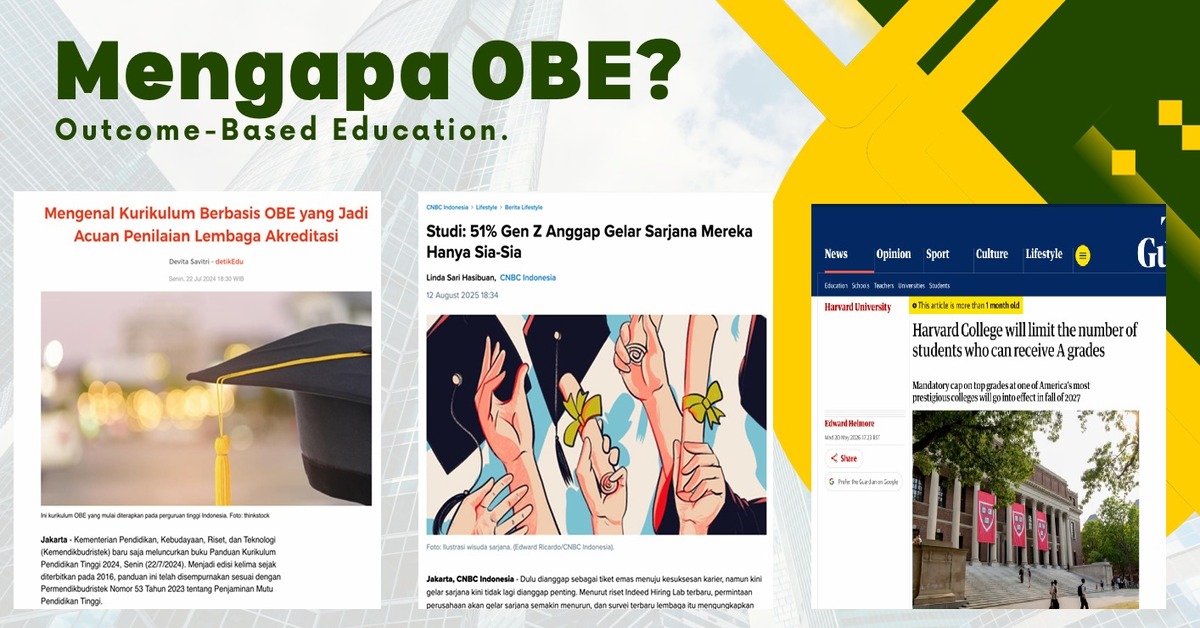
Responding to the Challenges of Our Time: Why Must Higher Education Shift to an Outcome-Based Education (OBE) Curriculum?
The world of work and the social landscape are changing at an unprecedented pace. Traditional educational models—which focus on what instructors teach in the classroom (input-based) or how long students spend in college (time-based)—are no longer relevant. Higher education institutions are now required to answer one crucial question from the world of work: “What can your graduates do?”
This is where the Outcome-Based Education (OBE) curriculum emerges as the definitive solution. OBE completely transforms the educational paradigm by flipping our way of thinking: we start with the end goal—namely, the specific competencies, skills, and attitudes that students must possess upon graduation—and then design the curriculum, learning methods, and assessments based on that end goal.
Why OBE?
There are three fundamental reasons why the transition to OBE is no longer an option, but a necessity:
1. Clarity of Focus: Students know exactly which competencies they are developing, and instructors have a clear compass for designing classroom activities.
2. Flexibility in Methods (Design Down): OBE allows for freedom in teaching methods as long as the ultimate goals are achieved. Learning shifts from simply memorizing theory to problem-solving (case-based) and real-world projects (project-based).
3. Accountability and International Standards: OBE is the global language of educational accreditation (such as the Washington Accord for engineering). Graduates of OBE curricula have greater international mobility because their competencies are recognized globally.
Responding to Environmental Changes: The Spectrum of Reactions by Educational Institutions
The implementation of OBE is not merely an administrative matter concerning the curriculum, but rather a reflection of how educational institutions respond to environmental pressures and the demands of stakeholders. When the business world, the government, and society demand graduates who are ready for the workforce, educational institutions generally exhibit one of the following four levels of response:
[Social Obligation] ➔ [Social Responsiveness] ➔ [Social Responsibility] ➔ [Social Impact Management]
1. Social Obligation
At this level, institutions implement OBE solely because they are compelled to do so by regulations. The focus is on legality and compliance. Institutions merely seek to meet minimum accreditation requirements or follow ministry directives. Their response is passive and reactive; OBE curriculum documents are created, but teaching methods in the classroom remain traditional.
2. Social Responsiveness
Institutions are a step further along. They not only comply with regulations but also begin to respond to market trends and pressures. When industries demand expertise in data analytics or artificial intelligence (AI), campuses quickly adjust their learning outcomes. This approach is pragmatic and adaptive, aimed at maintaining competitiveness and ensuring graduates’ employability.
3. Social Responsibility
At this stage, the impetus for change comes from within (ethical and moral considerations), rather than from external pressure. The university recognizes that producing incompetent graduates is a moral failure that harms the future of students and society. OBE is implemented in a substantive manner to ensure students receive the best possible education, regardless of whether it is overseen by an accreditation body or not.
4. Social Impact Management
This is the highest and most ideal level. Educational institutions act proactively as agents of change. Through the OBE curriculum, the university intentionally designs student learning outcomes to directly address real-world problems in society (for example: students’ final projects must solve problems faced by local small and medium-sized enterprises or address climate mitigation in the local area). The university measures its success by the extent of the positive impact it creates for its surrounding community.
Conclusion
The OBE curriculum is not merely a fleeting academic trend. OBE is a strategic tool that enables educational institutions to transform from merely fulfilling formal obligations (social obligation) into institutions capable of managing real social impact (social impact management).
By focusing on outcomes, we no longer produce graduates who merely “know a lot of things in theory,” but rather an educated generation that is “capable of accomplishing many tangible things” for the advancement of the nation. (AC)