
The 14th AICIF Highlights the Potential of Islamic Philanthropy in the Diaspora: Assoc. Prof. Dr. Jawad Z. Salic Calls for Strengthening the Legal Framework and Digitizing Waqf and Zakat in the ASEAN Region
JAKARTA, OCTOBER 14, 2026 — The 14th ASEAN Universities International Conference on Islamic Finance (AICIF) 2026 officially kicked off at the Swiss-Belhotel Serpong Ballroom. This prestigious international conference featured a panel discussion (Panel Discussion I) titled “Cross-Border Islamic Philanthropy in a Digital Age: Mobilizing Diaspora Giving for Sustainable Development in ASEAN.”
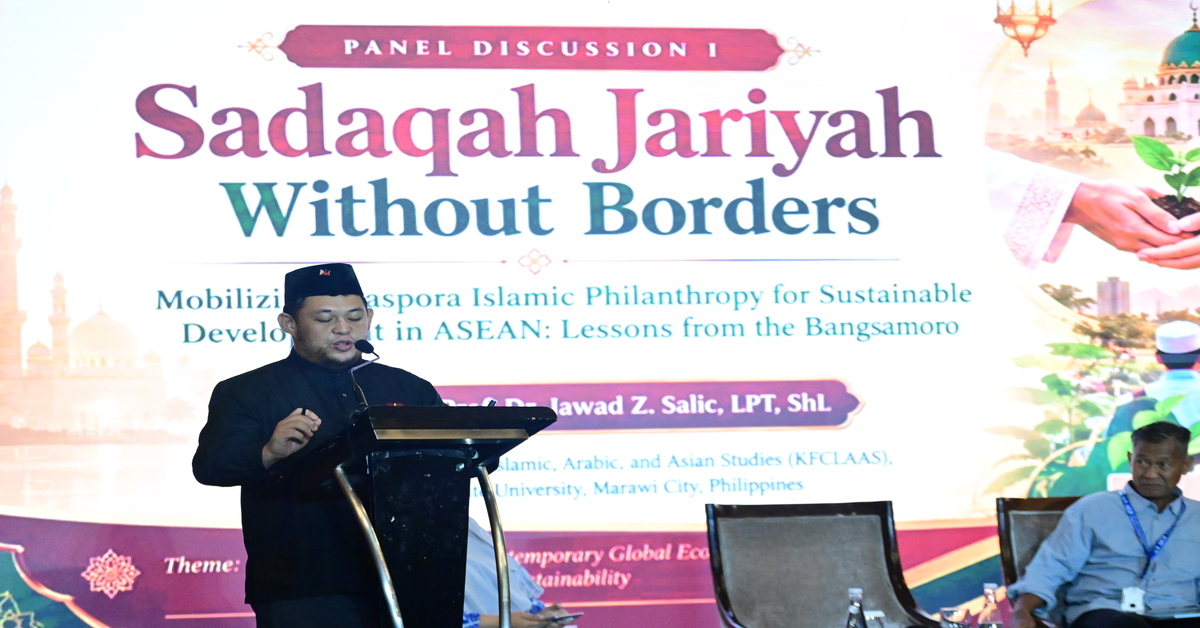
During the panel discussion, a Filipino expert in Islamic finance, Assoc. Prof. Dr. Jawad Z. Salic, LPT, ShL, from the King Faisal Center for Islamic, Arabic, and Asian Studies (KFCIAAS) at Mindanao State University, served as one of the keynote speakers. He presented a talk titled “Sadaqah Jariyah Without Borders: Mobilizing Diaspora Islamic Philanthropy for Sustainable Development in ASEAN: Lessons from the Bangsamoro.”
Key Takeaways from Dr. Jawad Z. Salic’s Presentation
In his presentation, Dr. Jawad Z. Salic highlighted the dynamics and challenges of managing Islamic philanthropy within Muslim minority communities in the Philippines (specifically the Bangsamoro/BARMM region in Mindanao), as well as the significant potential for regional Islamic philanthropic integration across ASEAN:
-
The Importance of Transforming Informal Channels into Structured Mechanisms (Amanah & Traceability)
-
The majority of contributions and donations from overseas Bangsamoro workers and diaspora still flow through informal channels (unrecorded, unprotected, and unreported).
-
Dr. Salic emphasized the necessity of traceable, trusted, and transformative mechanisms to ensure that every donation is managed responsibly (amanah) and sustainably.
-
-
Institutional Gaps and Regulatory Frameworks (The Inclusion Gap)
-
Muslims in the Philippines constitute a minority population (~6% of the 110 million+ total population) living under a secular legal system.
-
Although the Takaful Law (RA 11439) was enacted in 2019, the region still lacks a Shariah standard-setting body (such as the DSN-MUI in Indonesia or SAC in Malaysia) and currently lacks a specific legal category for waqf. Endowment assets such as mosques, madrasahs, and community lands are still treated as ordinary grant properties.
-
-
Digital Innovation for Transparency and Accountability (Amanah)
-
The adoption of modern technologies—such as digital zakat/sadaqah (QR codes, e-wallets with wakalah contracts), cash waqf (waqf al-nuqud), blockchain-based systems, and impact dashboards—is vital to ensuring transparency (auditability) and Shariah compliance.
-
"Technology moves funds, but governance builds trust," Dr. Salic asserted.
-
-
Empowering Local MSMEs Through Philanthropic Funds
-
Economic activity in Bangsamoro is predominantly driven by MSMEs (trade, agriculture, halal food, and textiles) that remain unreached by formal banking services (unbanked).
-
Diaspora waqf and zakat funds can be channeled into Shariah-compliant revolving funds (waqf-backed MSME funds) to stimulate the local economy.
-
-
Bridging Majority-Minority Community Cooperation in ASEAN
-
Dr. Salic invited Muslim-majority nations in ASEAN, such as Indonesia and Malaysia, to share regulatory standards, training modules, curricula, and institutional designs (Standards over Aid) to strengthen the regional Islamic finance ecosystem.
-
-
Concrete Steps: Initiating a Cross-Border Diaspora Waqf and Zakat Partnership
-
As a concrete next step, a research partnership and pilot digital giving corridor are proposed between KFCIAAS/Mindanao State University and higher education institutions across ASEAN to support the achievement of the Sustainable Development Goals (SDGs 1, 2, 3, 4, 10, 17) and Maqasid Shariah.
-
About the AICIF 2026 Conference
The ASEAN Universities International Conference on Islamic Finance (AICIF) is an annual inter-university conference in the ASEAN region that serves as a platform for academics, practitioners, and policymakers to discuss innovation, stability, and the sustainability of global Islamic economics and finance. The 14th AICIF was hosted by UIN Syarif Hidayatullah Jakarta, as a collaborative initiative with the International Council of Islamic Finance Educators (ICIFE) with the full support of the Deposit Insurance Corporation (LPS), Bank Syariah Nasional (BSN), Bank Syariah Indonesia (BSI), Bank Aladin, and Pegadaian Syariah. (AC)