
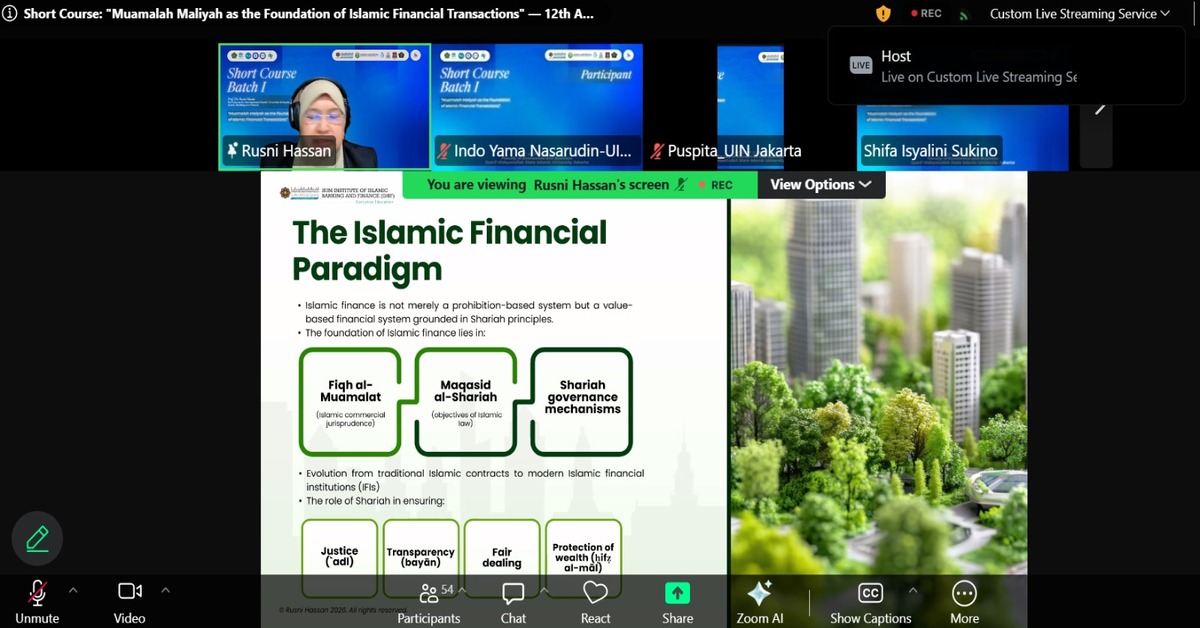
To Strengthen the Foundation of Global Islamic Finance, the Faculty of Economics and Business at UIN Syarif Hidayatullah Jakarta Hosts the International Short Course “Muamalah Maliyah” in Preparation for 14 th AICIF
JAKARTA, August 12, 2026 — The Faculty of Economics and Business (FEB) at UIN Syarif Hidayatullah Jakarta officially held the first batch of its International Short Course as part of a series of academic events leading up to The 14th ASEAN International Conference on Islamic Finance (AICIF 14). Focusing on the main topic “Muamalah Maliyah as the Foundation of Islamic Financial Transactions,” the program featured a world-renowned expert in Islamic finance, Prof. Datin Dr. Rusni Hassan from the IIUM Institute of Islamic Banking and Finance (IIiBF) at the International Islamic University Malaysia.
Held online via Zoom Meetings and a custom live stream, the short course was attended by dozens of academics, researchers, financial practitioners, and students from various universities across the ASEAN region. The program was specifically designed to deepen both theoretical and practical understanding of the architecture of the modern Islamic financial system, the jurisprudence of muamalah fiqh, and the governance of Sharia fatwas.
In her presentation, Prof. Datin Dr. Rusni Hassan emphasized that the global Islamic finance industry continues to experience rapid growth, with its asset value estimated to reach USD 6 trillion by 2024 and projected to surge to USD 9.75 trillion by 2029 (source: LSEG/ICD). She also highlighted Indonesia’s strategic position as a regional leader in terms of the number of providers of education, research, and publications in Islamic finance.
“Islamic finance is not merely a prohibition-based system, but rather a value-based financial system deeply rooted in Sharia principles to foster balanced, progressive, sustainable, and inclusive economic growth,” said Prof. Datin Dr. Rusni Hassan.
Key Points of the Short Course Material:
1. Foundations of Muamalah: A basic explanation of the principle of al-asl fi al-muamalat al-ibahah (all forms of muamalah transactions are fundamentally permitted unless there is evidence to prohibit them). Emphasis is placed on the principles of mutual consent (taradhi), justice (‘adl), transparency (bayan), and the protection of property (hifz al-mal).
2. Fatwa Methodology (Turuq al-Istinbat & Fatwa Governance): A detailed process of transforming Sharia law from Fiqh into Fatwa through the stages of Tahqiq al-Manat (fact-finding on transactions), Takyif Fiqhi (characterization of contracts), to the governance of collective fatwas that is independent, consistent, and accountable.
3. Sharia Governance Frameworks: The application of the Three Lines Model to Sharia financial institutions, namely Sharia Risk Management (Preventive), Sharia Review (Continuous/Real-time), and Sharia Audit (Independent Assurance).
4. Challenges in ESG Innovation & Integration: Harmonizing financial technology innovations (FinTech, Smart Contracts, AI) with Shariah compliance, as well as the natural convergence of the Maqasid al-Shariah principles with Environmental, Social, and Governance (ESG) standards through Green Sukuk and Islamic Social Finance instruments (Zakat, Waqf, Sadaqah).
As the host of AICIF 14, the Faculty of Economics and Business at UIN Syarif Hidayatullah Jakarta is committed to continuing to facilitate international academic forums to promote financial literacy, product innovation, and Islamic financial governance that adapts to the changing times. This short course serves as an important stepping stone leading up to the main 14th AICIF conference. (AC)